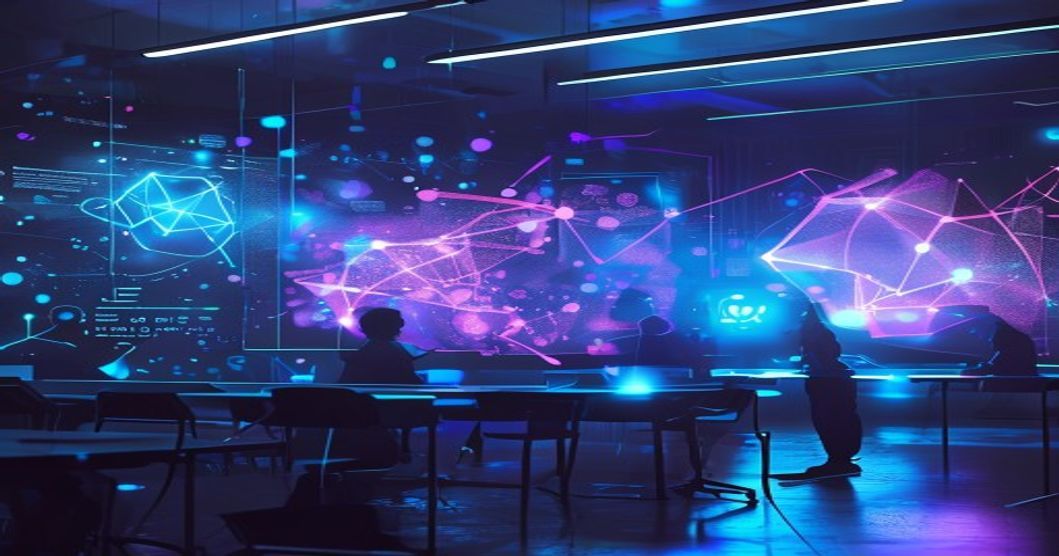
AI Revolution in Education: Personalized Learning in 2026
Published: April 22, 2026
Introduction
Education has always been one of humanity's most powerful tools for progress — but for centuries, it has struggled with a fundamental flaw: one size rarely fits all. A classroom of 30 students contains 30 different learning speeds, 30 different strengths, and 30 different ways of understanding the world. Traditional teaching methods, no matter how passionate the educator, have never been fully equipped to address this reality.
That is rapidly changing.
Artificial Intelligence is no longer a futuristic concept confined to science fiction or Silicon Valley boardrooms. In 2026, it is actively reshaping how students learn, how teachers teach, and how educational institutions operate. From adaptive learning platforms that adjust in real time to a student's performance, to AI tutors available 24/7, the transformation is both profound and accelerating.
Sponsored
大規模言語モデル入門
¥3,520
According to a 2025 report by HolonIQ, the global AI in education market is projected to reach $88 billion by 2030, growing at a compound annual growth rate (CAGR) of 43.3%. Meanwhile, studies from McKinsey & Company show that personalized, AI-driven learning approaches can improve student performance by up to 40% compared to traditional classroom instruction.
In this post, we'll explore the mechanics of AI-powered personalized learning, highlight real-world platforms making a difference today, compare the leading tools, and discuss what this revolution means for students, teachers, and policymakers alike.
What Is Personalized Learning — And Why Does It Matter?
Personalized learning is an educational approach that tailors the content, pace, and style of instruction to meet the unique needs of each individual learner. Rather than moving an entire class through the same curriculum at the same speed, personalized learning adapts dynamically based on what a student already knows, how they learn best, and where they need the most support.
Historically, true personalization required expensive one-on-one tutoring — a luxury unavailable to most students. AI changes this equation entirely.
Modern AI systems use techniques like:
- Machine Learning (ML): Algorithms that learn from student behavior and performance data to predict what content or difficulty level will be most effective next.
- Natural Language Processing (NLP): Enables AI tutors to understand and respond to students' questions in natural, conversational language.
- Knowledge Graphs: Structured maps of concepts and their relationships, allowing AI to identify gaps in understanding and recommend the most efficient learning path.
- Predictive Analytics: Tools that forecast when a student is at risk of falling behind, enabling early intervention.
For educators eager to deepen their understanding of these pedagogical foundations, books on personalized learning and modern education theory offer excellent starting points for both teachers and administrators.
How AI Is Powering the Personalized Learning Revolution
1. Adaptive Learning Platforms
Adaptive learning platforms are perhaps the most visible face of AI in education today. These systems continuously assess a student's responses, adjust the difficulty of questions, suggest new topics, and even change the format of content delivery — all in real time.
Khan Academy's Khanmigo, launched in partnership with OpenAI, is one of the most prominent examples. Rather than simply presenting video lessons, Khanmigo acts as an interactive Socratic tutor. Instead of giving students answers, it asks guiding questions to help them discover solutions themselves — mimicking the best practices of expert human tutors. In early pilot programs across U.S. school districts, students using Khanmigo showed a 32% improvement in math problem-solving accuracy over a single semester.
Duolingo, the language-learning app used by over 500 million people worldwide, uses a sophisticated AI model called Birdbrain to personalize lesson content. Birdbrain tracks more than 500 individual data points per learner, predicting the ideal moment to review a concept (a technique called spaced repetition) and adjusting lesson difficulty dynamically. The result? Duolingo reports that learners using its AI-personalized path progress 2x faster than those following a static curriculum.
2. AI Tutors and Conversational Learning
The emergence of large language models (LLMs) like GPT-4 and its successors has enabled a new generation of AI tutors capable of holding nuanced, context-aware conversations with students.
Carnegie Learning's MATHia is a prime example of AI tutoring done right. Developed over two decades with input from cognitive scientists at Carnegie Mellon University, MATHia uses AI to model each student's understanding of mathematics in real time. It identifies the specific misconception a student holds — not just that they got an answer wrong — and provides targeted feedback. A 2024 independent study found that students using MATHia for just 45 minutes per week performed 25% better on standardized tests than those receiving traditional instruction alone.
3. Intelligent Content Creation and Curriculum Design
AI is also transforming how educational content itself is created. Tools like Synthesis (originally built for SpaceX employees' children) and Coursera's AI-powered course builder allow educators to generate customized learning materials, quizzes, and assessments in minutes rather than weeks.
For curriculum designers and instructional technologists interested in the intersection of cognitive science and technology, books on learning science and instructional design provide invaluable frameworks for building effective AI-enhanced curricula.
Real-World Impact: Three Case Studies
Case Study 1: Georgia State University and AI-Powered Advising
Georgia State University (GSU) deployed an AI-powered academic advising system called Pounce — a chatbot that answers students' questions about enrollment, financial aid, deadlines, and academic planning 24/7. The results were remarkable:
- Summer melt (students who are accepted but never enroll) decreased by 22%
- First-generation college student retention improved significantly
- The system handled over 200,000 student interactions in its first year, with an 85% resolution rate without human escalation
GSU's success demonstrated that AI doesn't just improve learning outcomes — it can address systemic equity gaps in higher education.
Case Study 2: Squirrel AI in China
Squirrel AI (also known as Yixue Education) is perhaps the world's most ambitious AI tutoring company. Operating across thousands of learning centers in China, Squirrel AI uses a knowledge graph containing over 10,000 finely granulated knowledge points per subject. Rather than assessing students at the chapter level (as most tests do), Squirrel AI assesses mastery at the level of individual sub-skills.
In a rigorous randomized controlled trial published in a peer-reviewed journal, students using Squirrel AI for just two hours achieved learning outcomes equivalent to weeks of traditional classroom instruction. The system is estimated to be 10x more efficient than conventional teaching for remedial learners.
Case Study 3: New York City's Personalized Learning Initiative
New York City's Department of Education partnered with several EdTech companies to launch a citywide personalized learning initiative across 200+ schools. Using platforms including DreamBox Learning (for math) and Newsela (for literacy), teachers received real-time dashboards showing each student's progress, engagement levels, and areas of struggle.
After two academic years, participating schools reported:
- A 17% increase in students meeting grade-level math benchmarks
- Teacher satisfaction scores improved, with 78% of educators reporting more time for small-group instruction
- Chronic absenteeism dropped by 11% in pilot schools
Comparing the Leading AI-Powered Education Platforms
| Platform | Primary Use | AI Technology | Best For | Pricing (2026) |
|---|---|---|---|---|
| Khan Academy (Khanmigo) | K-12 tutoring, STEM | GPT-4 based LLM | Students & self-learners | Free / $9/mo premium |
| Duolingo | Language learning | Birdbrain ML model | Language learners of all ages | Free / $12.99/mo |
| Carnegie Learning MATHia | K-12 Mathematics | Cognitive Tutor AI | School districts | School licensing |
| Squirrel AI | K-12 all subjects | Knowledge graph AI | Remedial & advanced learners | Per-session fees |
| Coursera (AI features) | Higher ed & professional | LLM + adaptive paths | Adult learners, professionals | $49-$399/mo |
| DreamBox Learning | K-8 Mathematics | Adaptive engine | Elementary schools | School licensing |
| Synthesis | Problem-solving, STEM | Game-based AI | Ages 6-14 | $35/mo family |
The Role of Teachers in an AI-Powered Classroom
A common fear is that AI will replace teachers. The evidence strongly suggests the opposite: AI empowers teachers to become more effective, not redundant.
When AI handles routine tasks — grading multiple-choice assessments, tracking homework completion, identifying struggling students — teachers are freed to do what they do best: build relationships, facilitate deep discussions, mentor students through complex challenges, and inspire curiosity.
Think of it as the difference between a doctor using diagnostic AI software versus being replaced by it. The AI surfaces patterns and flags anomalies; the doctor applies judgment, empathy, and expertise to act on that information.
In schools using AI-assisted teaching tools, surveys consistently show that educators spend 30-40% less time on administrative tasks and report higher job satisfaction. The AI becomes a tireless, data-rich teaching assistant — one that never gets tired, never forgets a student's learning history, and is available at 2 a.m. when a student is cramming for an exam.
For educators navigating this transition, books on the future of teaching and EdTech integration offer both practical strategies and philosophical frameworks for embracing AI as a professional ally.
Challenges and Ethical Considerations
The AI revolution in

