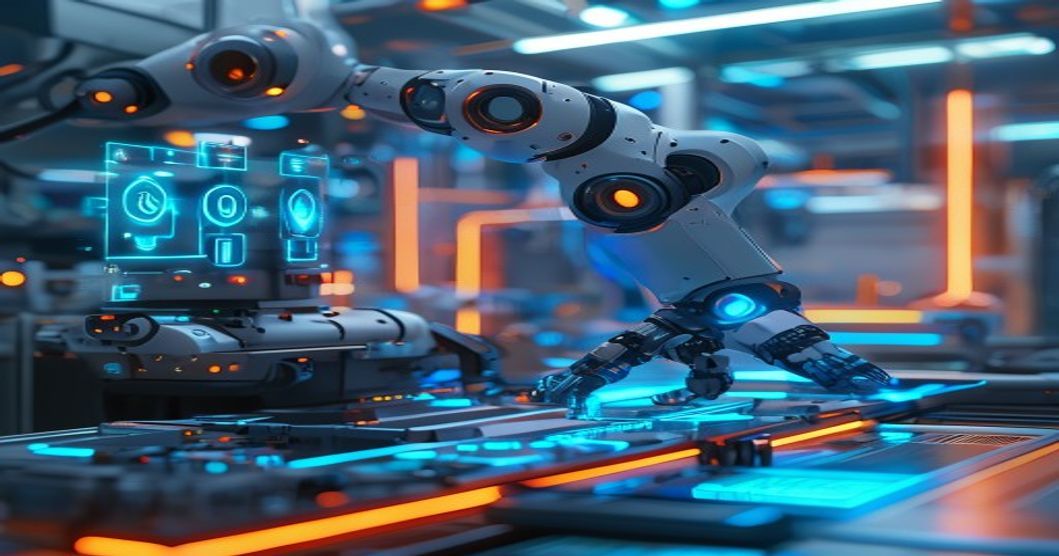
AI and Robotics in Manufacturing: The Industry Revolution
Published: April 29, 2026
Introduction
The factory floor of 2026 looks nothing like it did a decade ago. Where rows of human workers once performed repetitive assembly tasks, intelligent robots now collaborate alongside people, guided by AI systems that can predict failures before they happen, optimize production in real time, and adapt to changing demands without missing a beat.
AI and robotics in manufacturing isn't just a futuristic concept—it's the defining industrial transformation of our era. According to the International Federation of Robotics (IFR), the global stock of operational industrial robots reached 3.9 million units in 2025, a figure expected to surpass 5 million by 2028. Meanwhile, McKinsey estimates that AI-powered automation could add $3.7 trillion in value to manufacturing globally by 2030.
In this post, we'll explore exactly how AI and robotics are reshaping manufacturing, which technologies are leading the charge, real-world companies already reaping the benefits, and what this means for the future of industry.

Sponsored
大規模言語モデル入門
¥3,520
What Is Industry 4.0? A Quick Primer
Before diving into specifics, it helps to understand the context. Industry 4.0 refers to the fourth industrial revolution—the integration of cyber-physical systems, the Internet of Things (IoT), cloud computing, and artificial intelligence into manufacturing environments.
Think of it as a factory that can think. Machines communicate with each other, production data flows in real time to decision-makers, and AI algorithms continuously optimize every step of the process—from raw material sourcing to final quality inspection.
Key pillars of Industry 4.0 include:
- Industrial IoT (IIoT): Sensors embedded in machines collecting real-time operational data
- Digital twins: Virtual replicas of physical systems used for simulation and optimization
- AI and machine learning: Algorithms that learn from data to make predictions and decisions
- Collaborative robots (cobots): Robots designed to work safely alongside humans
- Edge computing: Processing data locally at the machine level for ultra-low latency responses
For readers who want to go deeper on this topic, a comprehensive guide to Industry 4.0 and smart manufacturing provides excellent foundational reading.
How AI Is Transforming Key Manufacturing Processes
1. Predictive Maintenance: Stopping Failures Before They Start
One of the most impactful applications of AI in manufacturing is predictive maintenance—using machine learning models to predict equipment failures before they occur.
Traditional maintenance was either reactive (fix it when it breaks) or preventive (service it on a schedule). Both approaches waste time or money. AI changes the game by analyzing sensor data—vibration, temperature, acoustic signals, power consumption—and detecting anomalies that signal impending failure.
Real-world example: Siemens Siemens has deployed AI-powered predictive maintenance across its gas turbine operations. Their system analyzes over 500 sensor data points per second and has reduced unplanned downtime by 36%. In an industry where a single turbine outage can cost upwards of $1 million per day, the ROI is staggering.
Impact by the numbers:
- Predictive maintenance can reduce maintenance costs by 25-30%
- Eliminate up to 70% of equipment breakdowns
- Extend machinery lifetime by 20-40% (Deloitte, 2024)
2. Quality Control and Computer Vision
Manual quality inspection is slow, inconsistent, and expensive. AI-powered computer vision systems can inspect thousands of products per minute with accuracy rates exceeding 99.9%—far surpassing human capabilities.
These systems use deep learning models trained on images of defective and non-defective products. Once deployed, they can detect microscopic cracks, surface defects, incorrect assembly, or dimensional deviations in real time.
Real-world example: BMW Group BMW uses AI-based computer vision at its Regensburg plant to inspect car body panels for surface defects as small as 0.3 millimeters. The system processes images in under 0.1 seconds per panel and has achieved a defect detection accuracy improvement of 32% compared to the previous manual method. Importantly, zero-defect panels proceed immediately without delay, while flagged items are routed for human review.
3. Supply Chain Optimization
AI is also revolutionizing supply chain management—helping manufacturers anticipate demand, manage inventory, reduce lead times, and minimize waste.
Machine learning models can analyze historical sales data, market trends, seasonal patterns, weather forecasts, and even geopolitical signals to generate demand forecasts that are 15-20% more accurate than traditional statistical methods.
Real-world example: Toyota Toyota's AI-enhanced supply chain platform, developed in collaboration with NTT DATA, uses graph neural networks to map supplier relationships across multiple tiers. During the semiconductor shortage of 2021-2023, the system helped Toyota identify at-risk supply nodes 6-8 weeks earlier than competitors, allowing proactive sourcing adjustments that kept production lines running when rivals were shutting down plants.
The Rise of Collaborative Robots (Cobots)
Traditional industrial robots are powerful but dangerous—they're caged away from humans for safety. Cobots (collaborative robots) are a new generation of lighter, sensor-equipped robots designed to work directly alongside people.
Key features of cobots include:
- Force-torque sensors that immediately stop movement if unexpected resistance is detected
- Vision systems enabling spatial awareness of human co-workers
- Easy programming often via hand-guidance (teach-by-demonstration)
- Flexible deployment on multiple tasks without extensive reconfiguration
Leading cobot manufacturers include Universal Robots (UR series), FANUC's CRX series, ABB's GoFa and SWIFTI, and Boston Dynamics' Spot-derived industrial platforms.
Cobots are particularly transformative for small and medium-sized manufacturers (SMEs) that can't afford fully automated lines. A UR10e cobot costs roughly $50,000–$70,000 and can be up and running in days, with payback periods often under 18 months.
Comparison of Leading AI and Robotics Platforms in Manufacturing
| Platform / Solution | Key Strength | Best For | AI Capabilities | Approx. Cost Range |
|---|---|---|---|---|
| FANUC AI Servo Monitor | Predictive maintenance | Large-scale CNC operations | Anomaly detection, vibration analysis | $20K–$100K/year |
| Universal Robots UR Series | Ease of use, flexibility | SME assembly, pick-and-place | Plug-in AI vision (3rd party) | $35K–$75K per unit |
| Siemens MindSphere | IIoT data platform | Enterprise-wide optimization | ML analytics, digital twins | Custom enterprise pricing |
| Rockwell Automation FactoryTalk | OT/IT integration | Discrete and process manufacturing | AI-driven OEE optimization | $50K+ setup |
| NVIDIA Isaac Sim | Robot simulation | R&D, training AI for robots | Photorealistic digital twin, RL training | Free (cloud compute costs vary) |
| ABB AbilityTM | End-to-end robotics ecosystem | Automotive, electronics | Predictive analytics, adaptive control | Custom pricing |
| Cognex Vision Systems | Machine vision inspection | Quality control | Deep learning defect detection | $10K–$50K per station |
AI-Powered Digital Twins: The Factory of the Future
A digital twin is a virtual, real-time replica of a physical asset, process, or entire factory. Fed by IoT sensors and powered by AI, digital twins allow manufacturers to:
- Simulate production scenarios without interrupting real operations
- Test equipment changes virtually before physical implementation
- Optimize energy consumption by modeling different operational parameters
- Train AI models in a safe virtual environment before deployment
Siemens NX and Dassault Systèmes' 3DEXPERIENCE platform are market leaders in industrial digital twin technology. General Electric's Predix platform uses digital twins to monitor over 4 million data points from aircraft engines in real time, reducing unscheduled maintenance events by 20%.
For those fascinated by the intersection of simulation and AI, books on digital twins and cyber-physical systems offer excellent deep dives into this rapidly evolving field.
The Workforce Question: Displacement vs. Augmentation
No discussion of AI and robotics in manufacturing is complete without addressing the workforce impact. The concern is real—the World Economic Forum projects that automation will displace 85 million jobs globally by 2025, while simultaneously creating 97 million new roles.
The reality in factories is nuanced:
Jobs being reduced:
- Repetitive assembly and sorting tasks
- Manual quality inspection
- Basic data entry and inventory counting
Jobs being created or elevated:
- Robot programming and maintenance technicians
- AI system trainers and validators
- Data analysts and process engineers
- Human-robot collaboration supervisors
The key concept here is augmentation—AI and robots handling the dangerous, dull, and dirty work while humans focus on judgment, creativity, and complex problem-solving.
Companies like Bosch have invested over €400 million in retraining programs for their workforce, helping factory workers transition into roles as "robot coaches" and AI system operators. Their experience shows that upskilling existing workers is often faster and more cost-effective than hiring new talent.
For manufacturing leaders navigating this transition, the latest books on workforce transformation in the age of automation offer valuable strategic frameworks.
Emerging Trends to Watch in 2026 and Beyond
Generative AI Meets Manufacturing
Large language models (LLMs) are beginning to enter the factory floor—not as chatbots, but as intelligent assistants for engineers. Systems like **Siemens'

