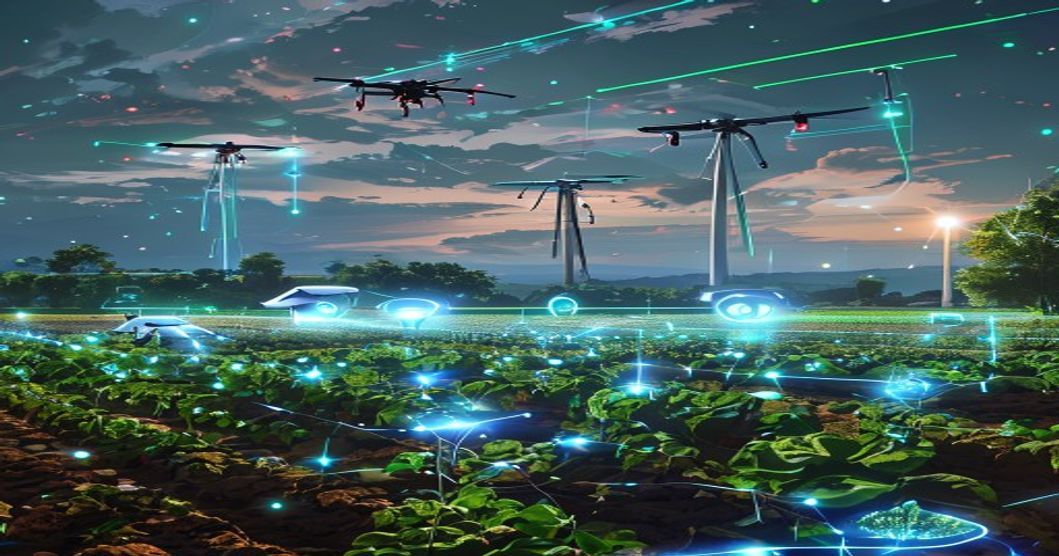
AI and Smart Farming: Transforming Agriculture Today
Published: April 29, 2026
Introduction
Agriculture has fed civilizations for over 10,000 years, yet the fundamental challenges of farming — unpredictable weather, pest outbreaks, soil degradation, and labor shortages — have never fully disappeared. Today, however, a technological revolution is rewriting the rules. Artificial intelligence (AI) combined with smart farming technologies is transforming how we grow food, manage resources, and sustain our planet.
According to a 2024 report by MarketsandMarkets, the global AI in agriculture market is projected to reach $4.7 billion by 2028, growing at a compound annual growth rate (CAGR) of 25.5%. This explosive growth reflects a simple truth: farmers and agribusinesses worldwide are recognizing that AI is no longer a futuristic luxury — it is a practical, profit-generating necessity.
In this post, we'll explore how AI is being deployed across the agricultural value chain, highlight real-world success stories, and give you a clear picture of the tools shaping the future of farming.

Sponsored
大規模言語モデル入門
¥3,520
What Is Smart Farming?
Smart farming (also called precision agriculture) refers to the use of modern technologies — including IoT (Internet of Things) sensors, GPS, drones, robotics, and AI — to monitor, analyze, and optimize agricultural processes. The goal is simple: produce more food with fewer resources while minimizing environmental impact.
Think of it this way: traditional farming relies on intuition and broad-stroke decisions ("water the whole field on Tuesday"). Smart farming, powered by AI, enables hyper-precise decisions ("irrigate the northeast quadrant by 15% more because soil moisture sensors detected a 23% deficit there").
If you want to build a deeper understanding of the technology behind these systems, books on precision agriculture and data-driven farming are an excellent starting point for both farmers and tech enthusiasts.
How AI Is Being Used in Agriculture
1. Crop Monitoring and Disease Detection
One of the most impactful applications of AI in farming is real-time crop health monitoring. Using computer vision models trained on millions of images, AI systems can detect diseases, nutrient deficiencies, and pest infestations far earlier than the human eye can.
Plantix, developed by PEAT GmbH, is one of the world's leading AI-powered crop advisory apps. It uses deep learning to analyze photos taken by farmers' smartphones, identifying over 500 plant diseases, pests, and nutrient deficiencies with up to 95% accuracy. The app has been adopted by over 10 million farmers in more than 100 countries, helping smallholder farmers in developing nations access expert-level diagnostics for free.
Studies show that early AI-based disease detection can reduce crop losses by 20–30%, a significant margin in an industry where margins are often razor-thin.
2. Precision Irrigation and Water Management
Water scarcity is one of the defining challenges of the 21st century. Agriculture accounts for approximately 70% of global freshwater consumption, making efficient irrigation not just a business issue but an environmental imperative.
AI-powered irrigation systems analyze data from soil moisture sensors, weather forecasts, satellite imagery, and historical usage patterns to deliver water exactly when and where it's needed.
The Climate Corporation (a Bayer subsidiary) offers its Climate FieldView platform, which integrates real-time field data with AI-driven recommendations for irrigation, planting density, and fertilizer application. Farmers using FieldView have reported water savings of up to 25% and yield improvements of 8–12% on average.
3. Autonomous Machinery and Robotics
AI-powered robots are increasingly handling labor-intensive tasks that were once exclusively human domains.
John Deere has been at the forefront of agricultural robotics. Its See & Spray Ultimate machine uses computer vision and machine learning to distinguish crops from weeds in real time, spraying herbicide only on weeds. The result? Up to 77% reduction in herbicide use, dramatically cutting costs and environmental contamination. The system processes visual data at 20 frames per second using onboard AI chips, making real-time decisions across a 60-foot boom.
Beyond spraying, autonomous tractors equipped with GPS and AI navigation systems can now plow, plant, and harvest with centimeter-level precision, even operating overnight without human supervision.
4. Predictive Analytics for Yield Forecasting
Knowing how much you'll harvest before the season ends is enormously valuable for farm planning, commodity trading, and food supply chains. AI-based predictive analytics models synthesize satellite imagery, historical yield data, soil composition, and climate forecasts to estimate crop yields months in advance.
IBM's Environmental Intelligence Suite (formerly IBM Watson Decision Platform for Agriculture) has demonstrated yield forecast accuracy improvements of up to 32% compared to traditional statistical models. This level of precision helps farmers make better decisions about storage, logistics, and sales contracts, potentially saving thousands of dollars per season.
5. Livestock Monitoring and Management
Smart farming isn't limited to crops. AI is also revolutionizing livestock management through:
- Wearable biosensors that monitor animal health, activity, and reproductive status 24/7
- Computer vision systems that track individual animals in real time
- Predictive health models that flag illness before visible symptoms appear
Connecterra, a Dutch agri-tech company, offers an AI platform called Ida that uses accelerometers attached to dairy cows to monitor behavior. The system can predict estrus (reproductive cycles) with 85% accuracy up to 3 days in advance, significantly improving breeding efficiency. Dairy farmers using Ida have reported milk yield increases of 8–10% through optimized herd management.
Real-World Case Study: AI Farming in Japan
Japan presents a compelling example of AI adoption in agriculture driven by necessity. With a rapidly aging farming population (the average Japanese farmer is now over 67 years old) and severe labor shortages, Japanese agri-tech companies have invested heavily in automation.
Spread Co., Ltd., based in Kyoto, operates the world's most technologically advanced indoor vertical farm — Techno Farm Keihanna. The facility uses AI to control lighting spectra, CO₂ levels, temperature, and humidity for optimal lettuce growth, producing 30,000 heads of lettuce per day with 98% less water than conventional farming and virtually zero pesticide use. AI-driven environmental optimization has reduced labor costs by 50% while increasing yield consistency.
Key AI Tools and Platforms for Smart Farming
The market for AI agricultural tools is growing rapidly, with solutions ranging from large enterprise platforms to affordable apps for smallholder farmers. Here's a comparative overview of the leading options:
| Platform / Tool | Primary Use Case | Key AI Feature | Best For | Pricing Model |
|---|---|---|---|---|
| Climate FieldView (Bayer) | Field analytics & yield mapping | Predictive analytics, satellite imagery | Mid-to-large farms | Subscription ($799+/year) |
| Plantix (PEAT GmbH) | Disease & pest detection | Deep learning image recognition | Smallholder farmers | Free / Freemium |
| John Deere See & Spray | Precision herbicide application | Real-time computer vision | Row crop farmers | Equipment purchase |
| Connecterra Ida | Dairy livestock management | Behavioral AI & biosensors | Dairy farms | Subscription-based |
| IBM Environmental Intelligence Suite | Yield forecasting & weather | NLP + predictive modeling | Enterprise agribusiness | Enterprise pricing |
| Taranis | Aerial crop scouting | High-res drone imaging + AI | Large-scale crop producers | Subscription |
| CropX | Soil & irrigation management | IoT sensors + ML optimization | Irrigated farms globally | Hardware + subscription |
This table illustrates how diverse the AI farming ecosystem has become. Whether you're a smallholder farmer in India or a 10,000-acre operation in the American Midwest, there is an AI-powered solution designed for your scale and needs.
Challenges and Considerations
Despite its promise, AI-driven smart farming faces real obstacles:
Data Privacy and Ownership
Farmers generate enormous amounts of data — and corporations are eager to collect it. Questions about who owns farm data and how it can be used are becoming critical policy debates. Farmers must carefully read platform terms of service before sharing sensitive operational data.
Digital Divide
Advanced AI tools require reliable internet connectivity, smartphones or tablets, and a baseline of digital literacy. Many smallholder farmers in sub-Saharan Africa, South Asia, and Southeast Asia still lack access to these prerequisites, risking a widening agricultural technology gap.
High Upfront Costs
Autonomous machinery, sensor networks, and drone fleets require significant capital investment. While ROI (return on investment) is demonstrable over time, the initial barrier can be prohibitive for small and medium-sized farms without access to agricultural finance.
Environmental and Ethical Concerns
As AI systems optimize for yield and profit, there's a risk of over-optimization — pushing ecosystems and soils to their limits in unsustainable ways. Responsible AI deployment in agriculture must incorporate long-term sustainability metrics, not just short-term productivity.
For a broader perspective on how technology intersects with sustainability and ethics in food systems, exploring books on sustainable agriculture and food technology can provide valuable context and inspire more holistic thinking.
The Future of AI in Agriculture
Looking ahead, several emerging trends promise to push smart farming even further:
Generative AI for Farm Advisory
Large language models (LLMs) are beginning to serve as 24/7 farm advisors, answering complex agronomic questions in local languages. Startups like Jiva (formerly Hesa) in India are deploying AI chatbots that provide tailored advice to millions of smallholder farmers in Hindi, Tamil, and other regional languages.
AI-Powered Gene Editing and Crop Breeding
Companies like Inari Agriculture are using AI to accelerate the development of climate-resilient crop varieties, potentially compressing decades of traditional breeding into just a few years using generative AI models trained on vast genomic datasets.

